
Published: October 16, 2026
Last reviewed: October 16, 2026
By: Credit Banana Editorial Team
Your credit card has several important dates. Three of them are easy to mix up:
- Statement closing date: Your billing cycle ends. The card company creates your statement balance.[2][3]
- Payment due date: Your required payment must reach the card company by its deadline.[2][3]
- Credit-reporting date: The card company sends account information to one or more credit bureaus. The timing depends on the card company.[4][5]
These dates may be close together. But each date has a different job.
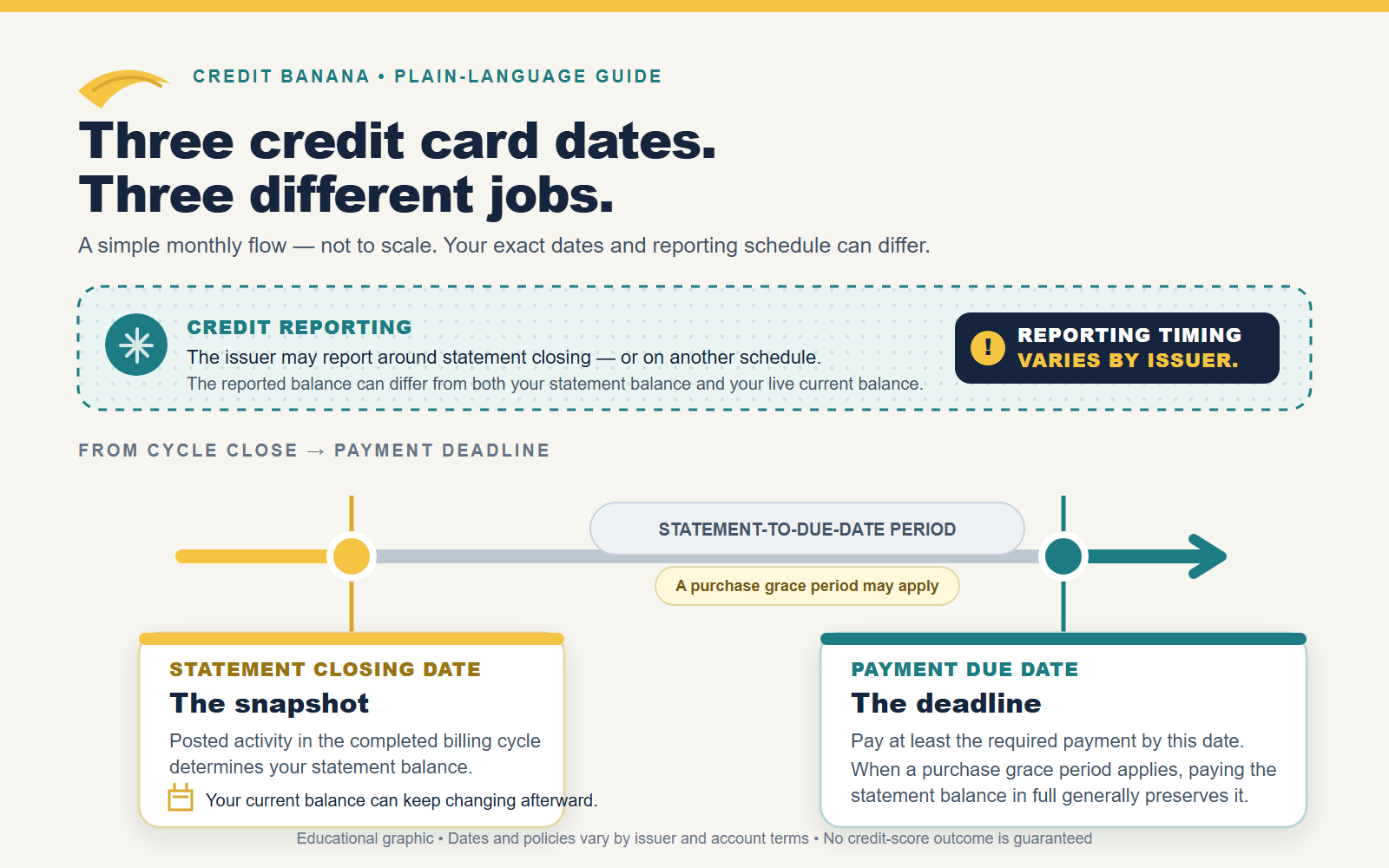
The three dates at a glance
Statement closing date
Your billing cycle ends on this date. Posted purchases, payments, credits, fees, and interest help determine the statement balance. This is usually not your payment deadline.
Payment due date
This is your payment deadline. At least the minimum payment must arrive on time. Paying only the minimum usually does not pay off the full statement balance.
Credit-reporting date
The card company may send a balance and account update to one or more credit bureaus. There is no single reporting date used by every card company.[4][5]
1. What is the statement closing date?
The statement closing date is the last day of a billing cycle.[3] Your statement must show the closing date and the balance on that date.[2]
You may see other names for it, such as:
- Closing date
- Billing cycle ending date
- Statement date
Card companies do not always use these labels in exactly the same way. Check the dates shown in your own account.
When the cycle closes, the card company creates your statement balance. A new purchase that posts after the cutoff will usually appear in the next billing cycle.[3]
Your current balance is different. It can keep changing after the statement closes. New purchases, payments, credits, fees, and interest can change it.[9]
Why does the closing date matter?
The closing date tells you which activity went on a certain bill. A card company may also report your account near this date. But that is not guaranteed. Equifax says there is no set day when every card company reports to the three major credit bureaus.[4]
2. What is the payment due date?
The payment due date is the deadline shown on your statement.[2][3]
To avoid being late, pay at least the minimum amount by the card company’s deadline. Follow its payment instructions. A cutoff time may apply. A mailed payment may need extra time.[3][10]
Card companies must have a process meant to deliver statements at least 21 days before the due date.[1] Even so, do not wait until the last minute.
Paying the minimum and avoiding interest are not the same thing.
A credit card grace period is the time between the end of a billing cycle and the payment due date.[1] If your card gives you a grace period on purchases, paying the full statement balance by the due date can help you avoid interest on those purchases.
Not every card has a grace period. Grace periods also usually do not cover cash advances.[1]
Special rules may apply if you carry a balance, lost your grace period, took a cash advance, or used a deferred-interest offer. A deferred-interest offer may have its own final payoff date. Minimum payments may not pay it off in time.[8] Check your card terms when you are unsure.
A simple payment order
- Protect the due date first. Pay at least the minimum by the deadline.[2][10]
- Pay the full statement balance when you can. This can help you avoid purchase interest if a grace period applies.[1]
- Pay earlier only as an extra step. An early payment may lower the balance that gets reported. But never miss the real due date while trying to time credit reporting.[4]
3. What is the credit-reporting date?
The credit-reporting date is when a card company sends account information to a credit bureau.[5] It is not a payment deadline.
Many lenders send updates about once a month. But they do not all use the same schedule.[5] A card company may report near the closing date or at another time. It may report to different bureaus on different dates. It may not report to every bureau.[4][5]
This is why a payment may show in your card account before it shows on your credit reports. The bureaus must first receive the new information.[4][5]
There is also no single national “credit score update day.” A score may change after a credit report changes. The result depends on the scoring system and the rest of the credit report. No payment date guarantees a certain score increase.[5]
How can you learn your card company’s pattern?
- Look for a “date updated” field on each credit report.
- Compare it with your statement closing dates for several months.
- Ask the card company when it normally reports and which bureaus it uses.
- Check again after the next billing cycle instead of expecting an instant update.
Treat the pattern as a clue, not a promise. Reporting practices can change.
A simple example
Suppose your card has a $3,000 limit. Your current balance is $1,200 a few days before the billing cycle closes.
- February 3: You make a $900 payment.
- February 5: The billing cycle closes. If the payment has posted and there is no other activity, the statement balance would be $300.
- March 2: The payment is due. At least the minimum must arrive on time. If a purchase grace period applies, paying the full $300 statement balance by this date would generally protect it.
- Reporting date: The card company might report near February 5. It might report on another date instead.
In this example, the balance on this card falls from 40% of its limit to 10%. That may change the credit-use information later seen by a scoring system. But it does not guarantee a certain score change.[5]
When should you pay?
For most people, a simple system works best:
- Use autopay for at least the minimum as a backup.
- Check the amount, bank account, start date, and first successful payment.
- Keep enough money in the bank account used for autopay.
- Use payment alerts when they are available.
- Try to pay the full statement balance by the due date when your budget and card terms allow.
- Keep checking your statements and payment confirmations. Autopay can fail, and a low bank balance can cause fees.[7]
You do not need to carry a balance or pay interest to build credit.[6] Paying on time and using a system you can repeat are more important than guessing a hidden reporting date.
Common mistakes
Mistake 1: Treating the closing date as the due date
The closing date ends the billing cycle. The due date is the payment deadline.
Mistake 2: Assuming the due-date balance is always reported
The card company may report a different balance or use a different date. Reporting schedules vary.[4][5]
Mistake 3: Paying only the minimum and expecting no interest
The minimum payment may keep the account from being treated as unpaid for that cycle. But avoiding purchase interest usually requires paying the full statement balance by the due date while a grace period applies.[1]
Mistake 4: Expecting an instant credit-score change
First, the payment must post. Then the card company must send an update. The bureau must add it to the report. A scoring system must then use the new report. Even after all of that, the size of the change can vary.[5]
Bottom line
- Closing date: Creates the statement balance.
- Due date: Sets the payment deadline.
- Reporting date: Sends an account update to one or more credit bureaus on the card company’s schedule.
Protect the due date first. Use the closing date to understand your bill. Treat the reporting date as changeable unless your card company confirms its normal practice.
Credit Banana provides general educational information. It is not personal financial, legal, or tax advice. Card terms and reporting practices vary. Read your current statement and card agreement.
Sources
- Consumer Financial Protection Bureau: What is a grace period for a credit card?
- Consumer Financial Protection Bureau: Regulation Z § 1026.7, Periodic statement
- Chase: What is a closing date on a credit card?
- Equifax: How often do credit card companies report?
- TransUnion: How often do credit reports and scores update?
- Experian: Will carrying a balance help my credit score?
- Consumer Financial Protection Bureau: How do automatic payments work?
- Consumer Financial Protection Bureau: How deferred-interest offers work
- Capital One: Statement balance vs. current balance
- Consumer Financial Protection Bureau: Regulation Z § 1026.10, Payments